
How to Compare Large Cap Mutual Funds: Beyond Returns, Rankings and Ratings
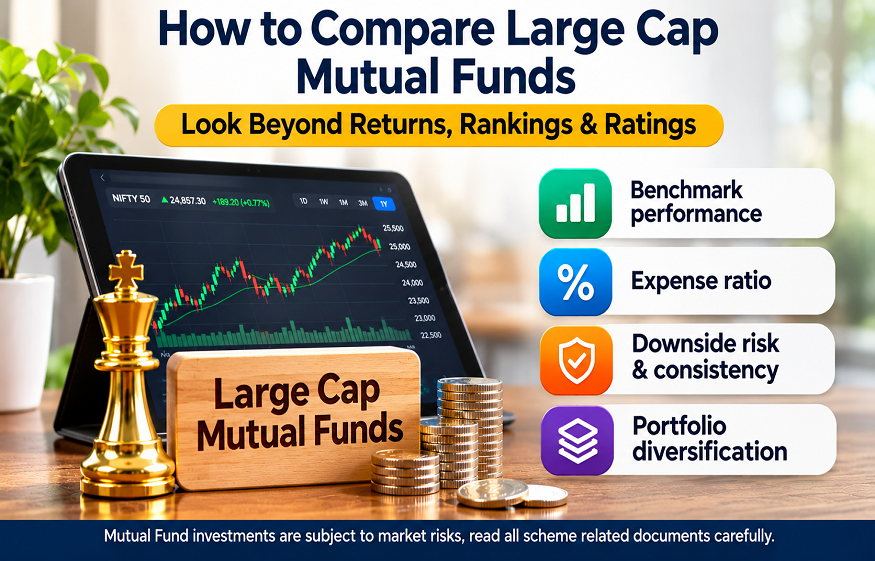
In looking at large cap mutual funds, you need to do more than pick the schemes that have had the highest returns or the best star ratings. Investors should consider a fund’s consistency of performance against its benchmark, its downside risk management, its expense control and the fund’s diversification of its portfolio across different market conditions. A fund that leads the tables in a market rally is not necessarily destined to show the same resilience in a correction. The idea should be to find a fund that fits your financial objectives, investment horizon and risk appetite, instead of picking a recent outperformer. A good understanding of rolling returns, expense ratios, portfolio concentration and risk-adjusted performance can help an investor make a more informed decision and structure a sustainable long-term equity portfolio.
1. Understanding the Role of Large Cap Mutual Funds
Large cap mutual funds invest mostly in large capitalized companies. These companies are already established and have a relatively large market capitalization. These schemes have to invest at least 80% of their assets in large-cap companies as per the mutual fund categorization framework of the SEBI. Large-cap companies are the first 100 companies as per full market capitalization. These businesses are typically more established, have better access to capital and have relatively mature business models. But their financial power doesn’t shield them from recessions, valuation corrections or market volatility. Large-cap funds can be a core equity allocation for investors who want to build long-term wealth without putting too much weight on mid- and small-cap companies. Despite all individual schemes being in the same investment category, they can differ greatly in terms of stock selection, sector allocation, investment philosophy and risk management. These differences make it important to evaluate individual funds.
2. Why Recent Returns, Rankings and Ratings Tell Only Part of the Story
On online investment platforms, one-year, three-year and five-year returns, fund rankings and star ratings are often displayed. These indicators can be useful starting points, but should not be used in isolation to make investment decisions. The fund’s recent success may be the result of its exposure to favoured sectors, short-term market movements, or concentrated holdings that have done well in the current economic climate. Fund ratings are also generally based on historical data and particular rating methodologies. Market conditions and scheme performance are different so may be different.
Here are three important questions investors should ask:
- Is the fund consistent in its performance across the different investment periods?
- Has its outperformance involved disproportionate risk?
- Does the investment strategy fit with the investor’s existing portfolio?
Historical performance provides context but cannot determine how a scheme will perform in the future.
3. How to Compare the Best Large Cap Mutual Funds Using Benchmark Performance
A meaningful evaluation starts with comparing the fund’s performance to its stated benchmark and not just on absolute returns. For instance, a large-cap fund that has generated 14% annualized returns while the benchmark has returned 16% has underperformed even if it has positive returns. In contrast, a fund that has returned 11% when its benchmark has returned 9% has shown relative outperformance. For a more meaningful comparison, investors should use the relevant Total Return Index (TRI), which includes dividends.
Why rolling returns matter
Rolling returns differ from point-to-point returns by measuring returns over multiple overlapping investment periods.
By looking at three-year and five-year rolling returns, investors can get a sense of:
- Consistency of historical performance.
- The incidence of beating the benchmark.
- The difference between positive and negative investment outcomes.
- Effect of different points of entry in the market.
A fund that consistently outperforms its benchmark over multiple periods may be more worthy of consideration than one whose historical outperformance is mostly tied to a particular market phase.
4. What Makes a Top Large Cap FundAcross Market Cycles?
Looking at a fund in rising markets alone will not tell you whether you are looking at a good investment strategy. Equally important is its behaviour during market corrections and recoveries.
Risk indicators that investors may look at include:
Maximum drawdown: The largest drop from a high to a low in the past value of a portfolio.
Sharpe ratio : Measures excess return over total volatility.
Sortino ratio: Measure of excess return to downside volatility.
Downside Capture Ratio: Indicates how a fund has performed historically in periods where its benchmark was down.
Recovery period: Measures the time it takes for the portfolio to return to a prior peak.
These indicators should be compared over the same time periods and using the same methodologies. A smaller historical drawdown may indicate better downside management in the period.
5. How Expense Ratios Influence Long-Term Investment Outcomes
The expense ratio is the annual operating expenses as a percentage of the mutual fund scheme’s assets. These costs are deducted from the scheme’s NAV and reduce the returns available to investors. Even a relatively small difference in expenses can be meaningful over longer investment horizons.
Let’s say you have two hypothetical large cap mutual funds with the same assumed gross annual returns but with different expense ratios.
Illustrative impact of expense ratios over 15 years
| Particulars | Fund A | Fund B |
| Initial investment | ₹5,00,000 | ₹5,00,000 |
| Assumed gross annual return | 12% | 12% |
| Annual expense ratio | 1.20% | 0.60% |
| Simplified net annual return | 10.80% | 11.40% |
| Illustrative investment horizon | 15 years | 15 years |
| Estimated final corpus | ₹23,28,786 | ₹25,25,309 |
| Difference in final corpus | — | ₹1,96,523 |
Illustrative calculation assumes annual compounding and approximates net returns by subtracting the expense ratio from gross returns. Actual expenses, returns and investment values will vary. Taxes and exit loads are excluded.
Lower expenses can improve investment efficiency when other factors remain comparable. However lowest expense ratio should not the fund selection criteria for investors.
6. Evaluating Portfolio Concentration and Diversification
Owning multiple stocks doesn’t necessarily mean you’re diversified. A large-cap fund may still be heavily invested in a few companies or sectors.
Investors should refer to the monthly portfolio disclosures and factsheets of the scheme and consider:
- Distribution to top ten holdings.
exposure to certain companies and sectors.
- Duplicates existing mutual fund holdings in portfolio.
- Changes in investment style and portfolio turnover
- Compliance with stated investment objective.
For example, an investor holding a Nifty 50 index fund may find many common stocks in a large-cap actively managed fund. These common exposures are known and can help avoid unintended concentration and needless duplication in the portfolio.
7. Comparing Two Hypothetical Large Cap Mutual Funds
Consider two hypothetical funds operating within the same category and following the same benchmark.
| Evaluation parameter | Fund A | Fund B |
| One-year return | 19% | 16% |
| Five-year annualised return | 13.8% | 13.5% |
| Five-year benchmark annualised return | 13% | 13% |
| Annualised benchmark outperformance | 0.8 percentage points | 0.5 percentage points |
| Frequency of benchmark outperformance across five-year rolling periods | 55% | 72% |
| Expense ratio | 1.20% | 0.60% |
| Maximum drawdown | −28% | −19% |
| Sharpe ratio | 0.75 | 0.95 |
| Top ten holdings allocation | 65% | 48% |
All figures are hypothetical and do not represent any existing mutual fund scheme.
Looking at the recent returns, Fund A looks more attractive. In this illustration, however, Fund B shows more frequent benchmark outperformance, lower expenses, smaller historical drawdowns and better risk-adjusted performance.
Consider the recovery needed after their respective drawdowns:
- Fund A’s 28% drop would require about a 38.9% gain to make up for it.
- Fund B needs to gain approximately 23.5% to recoup its 19% loss.
This is why higher historical returns are not necessarily associated with greater suitability to the investor.
8. A Practical Checklist Before Selecting a Large Cap Fund
Please refer to the following steps before you invest:
- Identify your financial objectives, investment horizon and risk tolerance.
- Compare funds within the same category and plan type.
- Assess rolling returns against the stated benchmark.
- Review risk adjusted performance and drawdowns.
- Look at expense ratios, portfolio concentration and overlap
- Evaluate fund manager track record and investment philosophy.
- Read the scheme documents, factsheets and the Riskometer.
- Consider applicable taxes and exit loads while switching funds.
You can find the relevant information to assess it on your own on the official AMC websites and AMFI and the established mutual fund research platforms.
Conclusion
Choosing large cap mutual fund involves a careful analysis of returns, expenses, portfolio construction and risk management. Rankings and ratings can be useful to create an initial shortlist, but they should not be a substitute for a thorough assessment of the underlying investment strategy. Investors should look for funds that match their financial objectives and their tolerance for market fluctuations and not for a fund that outperforms all others. A structured, evidence-based selection process can lead to better long-term investment decisions, discouraging unnecessary fund switching and performance chasing.
Frequently Asked Questions
1. How to find best large cap mutual fund?
Compare benchmark-relative performance, rolling returns, expense ratios, risk-adjusted returns and portfolio diversification and your investment goals.
2. Are large cap mutual funds safe investments?
Nope. Large-cap companies tend to be more established, but these funds are still subject to swings in the equity market, economic developments and possible capital losses.
3. Is a lower expense ratio better all the time?
Other things being equal, lower costs raise cost efficiency. Investors also need to look at investment strategy, consistency of performance and risk management.
4. How often do I need to review my large cap fund?
For the long-term investor a review every six to twelve months may be appropriate. Don’t change just because of short-term underperformance.
5. Should I choose an index fund or an actively managed large cap fund?
The choice will depend on investment preferences, costs and expectations. Active funds aim to outperform their benchmark while index funds aim to track their underlying benchmark, less costs and tracking differences.